Kayaking with Dolphins on Anna Maria Island
Search kayak with dolphins Anna Maria Island and you land on one trip: a two-hour guided sunset paddle in tandem sit-on-top kayaks, $60 per person, rated 5.0 from 68 reviews. It is the highest-scoring dolphin trip on this island, and it is also the one that sees the fewest dolphins. Both of those things are true for the same reason, and it is worth understanding before you book.
About the Trip
A silver Ford F-150 with a large box trailer in the car park, not a dock
Late afternoon, timed to finish at sunset, so the hour moves with the season
2 hours on the water
$60 per person, tandem kayaks; solo bookers get a single boat
5 and over
Florida Blue Adventures, sold through GetYourGuide
Check Dates for the Paddle
Live calendar and instant confirmation. Free cancellation up to 24 hours before the meeting time.
What the Trip Is
Two hours, shallow sheltered water, and a guide who knows which flats hold what. You paddle tandem sit-on-top kayaks, the stable kind you sit on rather than climb into, so nobody is trapped under a spray skirt. Solo bookers get a single boat. Instruction happens before you launch, and reviewers describe the paddling as not strenuous, which the water backs up: this is protected bay, not open Gulf, and it stays shallow a long way out.
The guides carry roughly 30 years of local experience between them and adjust the route to the day's tide and wind rather than running a fixed loop. Along the way they stop for whatever turns up. One traveller in June 2026 came back talking mostly about the guide catching crabs on a sandbar.
Where you meet
There is no shopfront and no dock. You look for a silver Ford F-150 pickup towing a large box trailer with the operator's signage, parked in the lot. Turning up expecting a marina building is the single most common piece of confusion on this trip, so put the exact meeting note from your confirmation into your phone before you drive over.
What the Law Lets You Do at Water Level
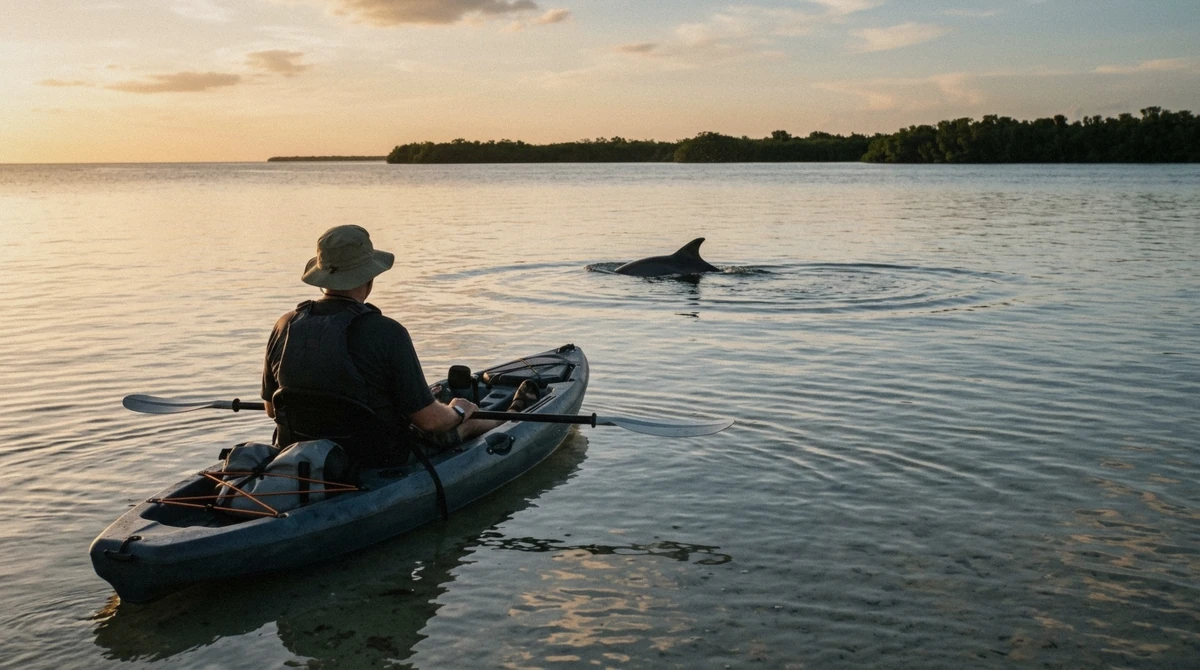
A kayak is quiet, low and slow, so dolphins treat it differently than they treat a boat. That does not create an exemption. NOAA asks anyone viewing wild dolphins to stay at least 50 yards away, and feeding, touching or chasing one breaks the Marine Mammal Protection Act, with fines up to $100,000 and up to a year in jail. The rule does not care what you are sitting in.
The practical version on the water is simple. If an animal comes to you, stop paddling, stay still and let it set the distance. If it moves off, it has decided. A dolphin that chooses to approach a stationary kayak is legal and it is the encounter people remember; a paddler who digs in and chases one is committing a federal offence and also, incidentally, guaranteeing the animal leaves.
The size difference nobody mentions
An adult bottlenose in this bay runs roughly 2.5 to 3.8 metres and several hundred kilograms, against a kayak and paddler that together might make 120. Nothing about that is dangerous in normal circumstances, and there is no record of a wild dolphin harming a paddler here. It is simply the reason guides keep a group together and off the animals rather than steering into them, and why nobody in this fleet sells swimming with dolphins.
Anyone who does is selling you a federal violation.
Kayak or Boat: The Honest Comparison
A two-hour boat covers the back bay, Longboat Key and open Gulf, and works several pods. A two-hour paddle covers a fraction of that ground. Over the same window the boat sees more dolphins, and anyone who tells you otherwise is selling.
What the kayak gains is everything the boat gives up. No engine noise. Eye level with the water rather than two metres above it. Stops for a manatee grazing seagrass, for crabs, for a spoonbill working the flat. And the 5.0 rating from 68 reviewers, against 4.9 on the busiest boat, reflects a small group with one guide rather than a deck of 40.
| Sunset kayak | Sunset boat | |
|---|---|---|
| Price | $60 per person | $57.50 per person |
| Rating | 5.0 from 68 reviews | 4.9 from 381 reviews |
| Group | Small, one guide | Up to 40 passengers |
| Ground covered | Sheltered shallow water | Back bay, Longboat Key, open Gulf |
| Dolphins seen | Fewer, closer, at eye level | More, from a deck |
| Effort | Two hours of easy paddling | Sitting down |
| You get wet | Yes | No |
| Photos | Guide's photos and video, free | Crew shoots on your phone, free |
What Is Included
The $60 covers the kayak, paddle, safety gear, instruction and the guide's own photos and video of your trip, handed over afterwards at no charge. That last item is worth more than it sounds when both your hands are on a paddle and your phone is sealed in a dry bag.
- Included: kayak, paddle and safety equipment, expert instruction, guiding and wildlife commentary, complimentary photos and video
- Not included: food and drinks, transport to the meeting point, gratuities
What to wear
You will get wet. Not swimming-wet, but spray, drips off the paddle and a soaked seat are all normal.
- Quick-dry clothing rather than jeans, and shoes you do not mind soaking
- Sunglasses with a retaining strap, since anything that goes in the water is gone
- A hat and sunscreen applied before you launch
- Water to drink, because two hours of paddling in Florida humidity works you harder than it feels
- A waterproof case for your phone, or leave it in the car and rely on the guide's photos
How the Two Hours Run
-
Find the trailer
Meet at the silver pickup and box trailer in the car park. Kayaks come off the trailer here.
-
Instruction on the sand
Paddle technique, safety basics, and what the guide expects if wildlife comes close.
-
Launch into sheltered water
Shallow, calm bay water. Groups stay together from the start.
-
Working the flats
The guide reads the tide and moves the group between grass flats and channels where animals feed.
-
Sandbar stop
A break on a bar, which is where the crabs, shells and most of the photos happen.
-
Paddle back into the sunset
The return leg is timed so the last stretch is under the best light of the day.
Where It Runs
The trip works the sheltered water between the island and the mainland. Your confirmation carries the exact car park.
When to Go
Dolphins are resident here, so no month is a wasted month. What moves is everything around them. Manatees crowd into warm, sheltered shallows once the Gulf drops below about 68°F, putting the best odds between November and March, and a manatee at kayak level is a better story than a manatee from a deck. Water runs from about 65°F in the coldest weeks to the high 80s by late August.
The trip finishes at sunset, and sunset here swings from about 5:36pm on 1 December to about 8:31pm on 1 July, so the meeting time shifts by nearly three hours across the year. Summer brings the other complication: July and August each average around 193 mm of rain, and an afternoon storm on open water is the one thing that cancels a paddle outright.
Tide and wind decide the day, not the forecast
Two hours of paddling in sheltered water is easy when the tide is with you and hard when a 15-knot afternoon sea breeze is against you on the way back. Guides pick the launch by the day's conditions rather than running one fixed route, which is why the meeting point is a trailer that can go to several shorelines.
Low tide exposes the grass flats and concentrates the wading birds, which is good for everything except the last hundred metres back to the sand. High tide floods the mangrove edges and lets a kayak get into water a boat cannot reach. Neither is better; they simply make different trips, and neither one is something you can pick when you book.
Manatees have their own rulebook
Dolphins are not the only protected animal in this water. Manatees are covered by the same federal law plus Florida's own protections, so the rules are identical in practice: look, do not touch, do not feed, do not follow, and never separate a calf from its mother.
A manatee that surfaces beside a kayak will usually ignore you completely, which is the entire appeal. Guides here ask paddlers to raise a hand rather than a paddle when they spot one, so the group stops instead of drifting into the animal. In winter, when the Gulf sits below about 68°F, this comes up on most trips.
For the wider picture, when to go and why the tide matters covers the whole year, and what to wear on the water has the kit list.
Who It Suits
This is the trip for people who would rather be in the water than above it, and who accept a smaller dolphin count as the price.
- Book it if you want the encounter at eye level and enjoy the paddling as much as the wildlife
- Weigh it against every boat trip running dolphin tours on this island, which is where the price-per-head maths for larger parties lives
- Book it if you are travelling with older children, since 5 is the minimum age and reviewers bring 8 to 15-year-olds regularly
- Take the boat from Holmes Beach instead if you want the highest number of dolphins in two hours, or if anyone in the party cannot paddle
- Skip it if you want to stay dry, if a child is under 5, or if two hours of light exercise in humidity does not sound like a holiday
Questions About the Paddle
Can you really kayak with dolphins on Anna Maria Island?
You can paddle in water where resident bottlenose dolphins live, and they sometimes come close to a stationary kayak. What you cannot do is swim with them, touch them, feed them or chase them, all of which break federal law. Guides run the trip so that any encounter happens on the animal's terms.
How much is it and how long?
$60 per person for about two hours on the water, in tandem sit-on-top kayaks. That includes gear, instruction, guiding and the guide's photos and video. Free cancellation up to 24 hours before the meeting time.
Is it safe to be that close to a wild dolphin?
Yes, with a guide and normal behaviour. Adults run roughly 2.5 to 3.8 metres and several hundred kilograms, so the sensible rule is to stay still and let them pass rather than paddling toward them. There is no record of a wild dolphin harming a paddler on this stretch of coast.
Do you need paddling experience?
No. The water is shallow, sheltered and calm, instruction happens before launch, and reviewers describe the paddling as not strenuous. Sit-on-top kayaks are the stable, beginner-friendly kind.
Where do you meet?
At a silver Ford F-150 pickup towing a large box trailer with the operator's signage, in a car park rather than at a dock or a shop. The exact location is on your confirmation.
Are children allowed?
Children of 5 and over, yes. Under 5, no. Families with children between 8 and 15 turn up throughout the reviews, and guides adjust the pace to the group.
What should you bring?
Quick-dry clothes, shoes that can get wet, sunglasses on a retaining strap, a hat, sunscreen and water. Leave anything you cannot afford to soak in the car, or seal your phone in a waterproof case.
Kayak or boat, which sees more dolphins?
The boat, without question. It covers the back bay, Longboat Key and open Gulf in the same two hours the kayak spends on a few flats. The kayak trades numbers for silence and eye-level distance, plus manatees, birds and a sandbar stop the boat runs past.
What Recent Paddlers Wrote
Our family of six had a wonderful sunset tour with Ben. He tailored our tour to suit our varying ages and we were lucky enough to see both dolphins and manatees.
The sunset tour was absolutely beautiful. We saw dolphins, birds, and even a manatee. The guides were fun, knowledgeable, and made the trip unforgettable.
The guides were very knowledgeable of the area and mindful of everyone's paddling pace. The water in this area is shallow and calm, so this kayak is not strenuous.
Quotes reproduced from verified bookings on the operator's GetYourGuide listing, shortened for length and otherwise unchanged. Rating and review count read July 2026.